
A new report from the UK’s National Audit Office (NAO) dropped recently, and the numbers are frankly terrifying. “Under the Energy Company Obligation (ECO) scheme, 98% of homes retrofitted with external wall insulation) have major issues requiring remediation. That is not a typo. 98%.
Internal wall insulation (IWI) was a little better, with about a third (29%) of installations failing. That equates to roughly 23,000 external wall insulation homes and 11,000 internal wall insulation homes that are now liabilities rather than assets.
A checklist of what not to do
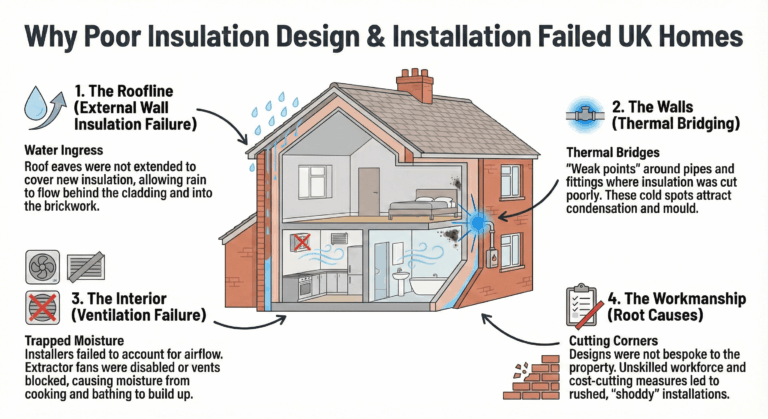
The specific failures cited in the report are a masterclass in bad building practice. On the exterior, we see water ingress because roof eaves weren’t extended to cover the new insulation, and thermal bridges where installers left gaps around gas pipes. In some cases, gutters weren’t even reinstated, dumping water directly onto the walls.
Inside, ventilation—the lungs of a home—was frequently ignored or actively made heaps worse. There were reports of installers disabling cooker hoods or failing to connect fans, leaving walls running with condensation.
Retrofits are black belt design challenges
The report blames “cutting corners” to minimize costs and the use of designs that weren’t bespoke to the property. I agree. You cannot simply slap insulation onto an existing structure and hope physics takes a holiday. Retrofit projects are “black belt” design jobs—significantly harder to execute correctly than new builds.
Don’t ignore the ventilation
Many of these failures stem from reducing ventilation by blocking vents to underfloor spaces, fans etc. As I’ve always said, you must heat and ventilate. Every retrofit needs a strategy for continuous mechanical ventilation, ideally MVHR.
Don’t let this happen to your project. Start with an educated designer who understands the building envelope. Our retrofit expert course provides the necessary building science foundation for both tradespersons and consultants to avoid these expensive disasters.
Report is here: