
I’ve been deep in the weeds working on the Deep Energy Retrofit Guide for New Zealand, and naturally, that means looking overseas for data we simply don’t have here yet. I came across a report by the UK Passivhaus Trust: A Retrofit Costs Comparison Translating Expenditure to Value that stopped me in my tracks.
They analyzed actual project costs across a range of retrofit approaches, comparing the full-fat EnerPHit standard against what we might call “EnerPHit lite” options standards like AECB CarbonLite, Energiesprong, and Energy Efficiency Standard for Social Housing post 2020 (EESSH2). My expectation was that these lighter standards would be cheaper and possibly even more cost-optimal.
The data suggests otherwise.
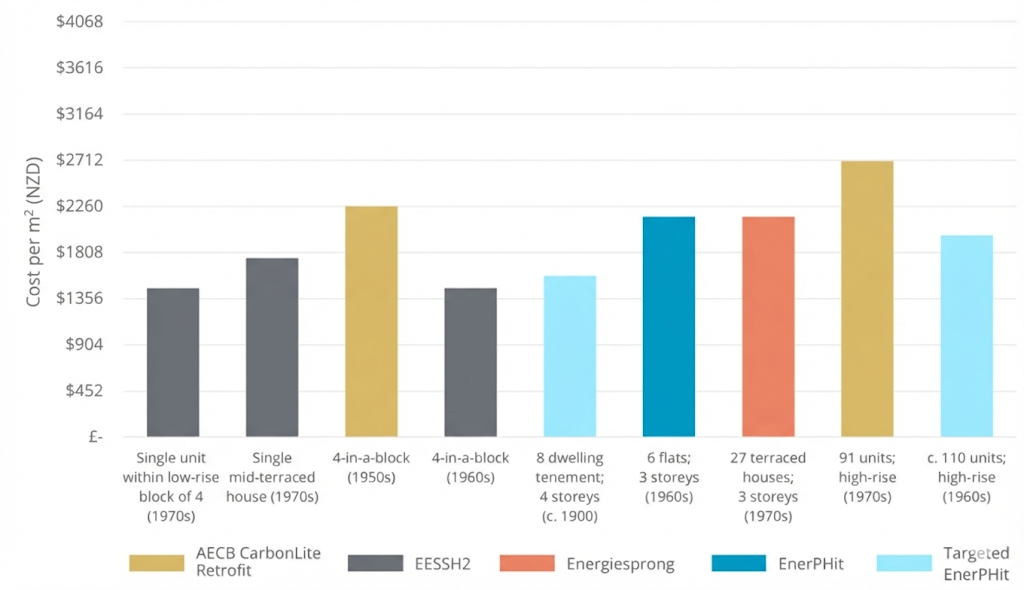
Graph from A Retrofit Costs Comparison, January 2026. Converted to NZD by Jason Quinn.
The results were unambiguous: deep retrofit is expensive, whichever route is taken. Surprisingly, EnerPHit projects landed in the same cost per m² region as the “easier” alternatives. If you’re going to spend the money, you might as well get the certified performance and the quality assurance that comes with it.
Another bubble burst by this report is the idea that scale automatically equals savings. It is often mooted as self-evident that doing 100 homes is cheaper per unit than doing one. The data here didn’t support that assertion. It turns out the complexity of the project is the determining factor, not just the number of dwellings.
So, what’s the pragmatic path forward? The Trust emphasizes starting every project with an EnerPHit Retrofit Plan (ERP). Accurate modelling in PHPP provides a solid baseline. Even if you don’t aim for full certification immediately, this structured process ensures you aren’t baking in mistakes or missing opportunities.
The bottom line is that retrofit is costly, so we need to ensure that expenditure translates into real value health, resilience, and guaranteed performance.
Reference: