I’m often asked what an energy-efficient, low-emissions HVAC system actually costs to install here in New Zealand. The short answer is: we don’t have enough local data. But looking at a recent, highly detailed study from British Columbia, the bottom line for a complete system is around $215 NZD per square metre.
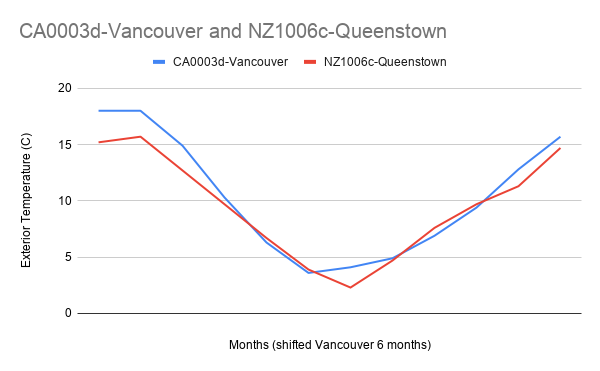
The ZEBx study looked at 20 homes. Now, before you dismiss Canadian data, remember that Vancouver and Queenstown have remarkably similar temperature profiles once you shift the seasons to align. The study defined total installation cost as the space heating, cooling, and ventilation systems (like an MVHR or ERV), explicitly excluding domestic hot water. Heat pumps served as the primary energy source for 19 of the 20 homes.
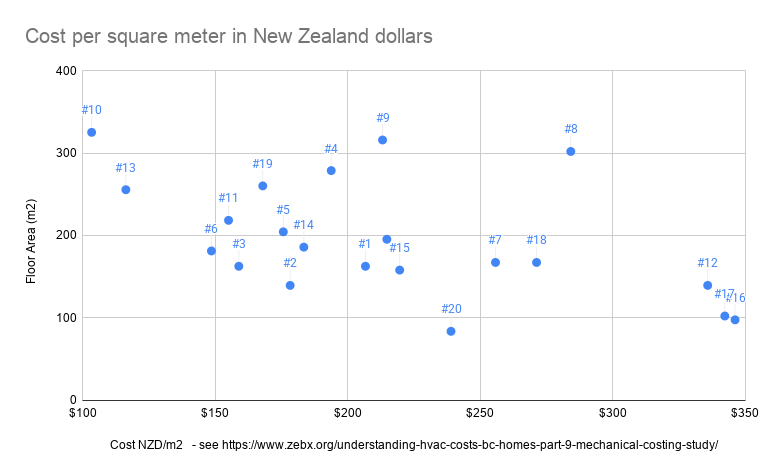
Graph converted by Sustainable Engineering Ltd. using CAD to NZD (1.2) and SF to SM (0.0929). Note average cost is $215 NZD per m2 and 195 m2 of house.
The average HVAC installation cost across all projects was $16.58 CAD per square foot. Converting that to local terms (CAD to NZD at 1.2, and square feet to square metres), the average installation was $215/m2 NZD. That sounds reasonable. If someone told me that a good quality MVHR and a high-wall heat pump in a 120m2 Passive House was $26,000 installed I wouldn’t be surprised.
Of course you have to dig into the data to see the variance. One 280m2 Vancouver project had ten contractors quote the job. The average was $60,511 NZD, but bids ranged wildly from $44,500 to $87,000! If your quotes fall within the typical $156 to $221 NZD/m2 range, you’re in the right ballpark. Costs fluctuate based on house complexity, number of zones, controls, and contractor standards. Don’t do stupid stuff, please, right? Get multiple quotes.
The point I want to make here, is that we need better local numbers. Here at SELtd, we’d love to work with Passive House homeowners and builders to build a database of installed HVAC data.
Reference:
Note Vancouver Canada and Queenstown New Zealand have similar temperatures summer/winter. In the chart below we’ve shifted the Vancouver temperatures six months to line up the seasons from northern to southern hemisphere.