
I wanted to point out a recent LinkedIn post by Sally Godber from WARM in the UK. I know Sally from discussions at a few Passive House conferences; she is a straight shooter and worth listening to.
She makes a point I hadn’t considered and really should have: if you care about operational carbon (while not increasing embodied carbon) in construction, you need to be going for airtightness in a big way.
Her team at WARM has been running whole life carbon analyses on their design projects. They found a fascinating relationship between upfront carbon—the emissions to produce and transport materials—and the energy used for heating.
The bottom line is this: once you commit to an airtightness layer (say, targeting below 3 m³/h/m² @ 50Pa), pushing that quality to Passive House levels (0.4 m³/h/m²) requires virtually no extra embodied carbon.
Why? Because the “stuff” you need is the same. You are using the same membranes and tapes. The difference isn’t in the quantity of materials; it’s in the quality of the execution.
Sally shared data from a timber frame project (a terrace worked on with Mikhail Riches for City of York Council) that illustrates this perfectly:
- Material Impact: The specific airtightness products (membranes) represent a tiny fraction of the upfront carbon.
- The Payback: While the carbon cost of the materials remains static between a standard build and a high-performance build, the result is drastically different. The less airtight building results in 40% greater heat losses.
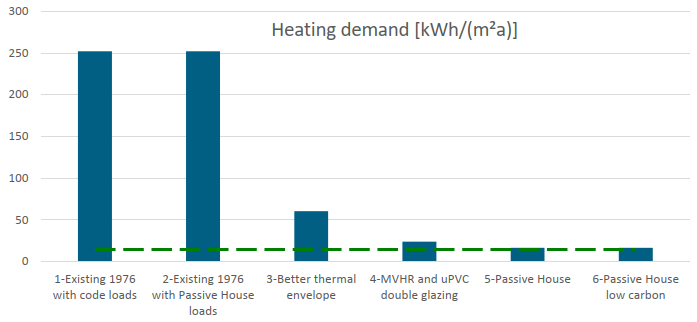
Looking at this retrofit project we’ve calculated at Sustainable Engineering. The giant reduction with a ‘Better thermal envelope’ hides the fact that over 1/3rd of the energy savings came from airtightness*.
By doing the job properly, you enjoy a massive saving in energy, a more durable envelope, and better control of indoor air quality—all without adding “more stuff.”
If you are worried about the practicalities of hitting those low numbers on site, don’t be. It’s about attention to detail, not reinventing the wheel. As Sally notes, good airtightness can be low risk with the right advice.
Reference Sally Godber on LinkedIn
* The graph is for a typical 1970s home in the north island of New Zealand, as is usual practice these numbers assume the home is heated to 20C all the time throughout the home and ventilated properly for health and thus excludes pre-bound and re-bound effects.