
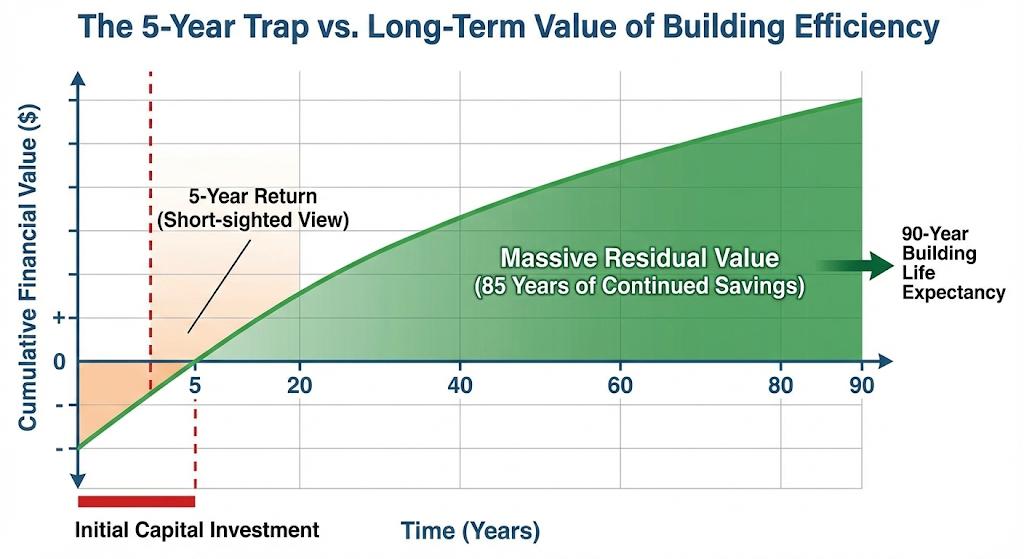
Retrofitting for performance only makes sense financially, at least when you’re already renewing a building element. Ripping off perfectly good cladding to add insulation is a tough sell, but doing it when the cladding has failed? Now you’re only paying for the insulation, as the cladding and scaffold are “anyway” costs. Even then, these upgrades are hard to justify if you’re using a tiny 5-year ROI window. That’s nonsense. If a home lasts nearly a century, a 5-year return ignores the massive residual benefit left on the table. To calculate that value, we need to know how long homes actually last. Ivan Johnstone’s paper provides that vital data.
As part of a deep energy retrofit or EnerPHit plan, your designer can use the financial tools built into PHPP to consider the energy savings against the additional cost (over the necessary maintenance or replacement required anyway). They can convert the savings over time to a current benefit or Net Present Value (NPV), taking into account inflation and returns. Alternatively, they can convert the additional capital into annual money amounts to be compared directly against the savings each year. Both methods require knowing the expected lifespan of the building or component to properly account for the residual value at the end of the finance period.
So, what is that lifespan? Johnstone’s research shows the “normal life” of a New Zealand dwelling the point where 50% of a cohort is lost is approximately 90 years. While the total economic life can stretch to 130 years, that 90-year mark is the anchor for our modeling. Interestingly, “dynamic mortality” is driven by the expansion rate of the housing stock; when we’re building fast, we demolish older stock sooner as quality expectations rise.
Don’t under-specify the bones of a building that will be around until the 22nd century.
Master the art of the retrofit
If you’re a designer and want to be able to run these numbers, we are running our Retrofit Expert course starting February 24, 2026. It is designed specifically for NZ and Australia and covers this financial analysis in a practical way.
Master the art of the retrofit here: https://sustainableengineering.co.nz/retrofitexpert/
Reference
Johnstone, I. M. (1994). The Mortality of New Zealand Housing Stock. Architectural Science Review, 37(4), 181-188. 10.1080/00038628.1994.9697345.
https://www.researchgate.net/publication/233262335_The_Mortality_of_New_Zealand_Housing_Stock