
We all know the stats. A massive portion of the housing stock across Australia and New Zealand is shockingly poor—cold, damp, and profoundly unhealthy. Fixing these thermal wrecks is the biggest challenge and opportunity facing our industry over the next decade.
But retrofitting is much harder than building new. You have to diagnose the patient before you can cure them. Here is the hard truth: if you get the physics wrong—particularly with internal insulation—you risk rotting the framing out from under the new lining.
To help you avoid those expensive disasters, we are offering the Retrofit Expert course. This is an advanced certification for professionals who want to master the complexities of EnerPHit (or Passivhaus/Passive House retrofits), step-by-step renovations, and advanced moisture management.
Who is this for?
This course covers two streams. Everyone is welcome, but you must hold a valid Passive House or Passivhaus certificate to sit the exam.
- Tradespersons (2 weeks): Focuses on practical execution and what to watch out for. We cover the "4 Control Layers" (Water, Air, Vapour, Thermal), how to install insulation and airtightness layers, dealing with thermal bridges, and window installation in retrofit contexts.
- Designers/Consultants (4 weeks): Covers everything the trades learn, plus a deep dive into PHPP for retrofits, economic comparisons, and an introduction to the tricky hygrothermal analysis required to ensure durability.
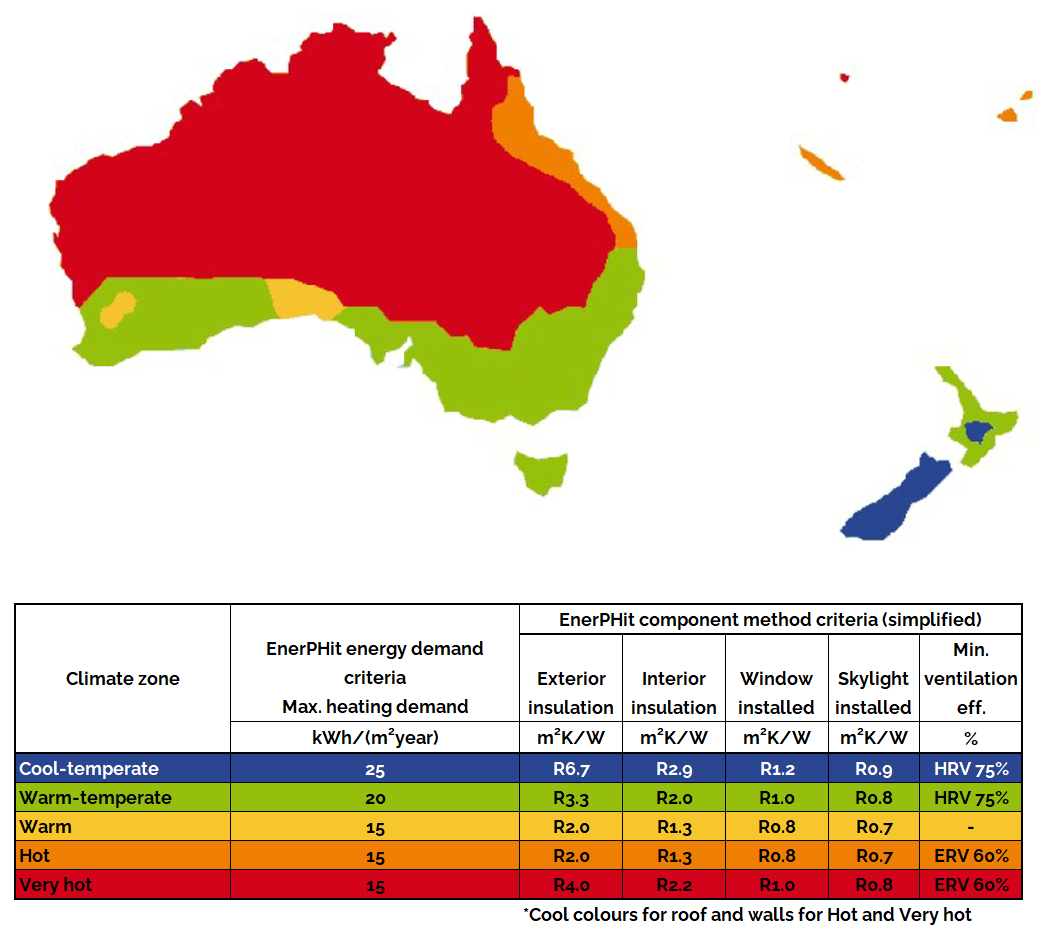
Image of Australasia with climate zones from PHI window certification criteria publication and are approximate.
Why Choose This Course?
- Regional Specificity: Designed specifically for New Zealand and Australia with a focus on lightweight timber framing and masonry common to our region.
- All-Climate Coverage: We have integrated our "Stay Dry" moisture workshop into this course to ensure you understand building physics across all Australian and New Zealand climates. We now include specific sections on warm, tropical, and hot climate retrofits, ensuring you are equipped for projects from the Snowy Mountains to the Top End.
- Step-by-Step Methodology: We move beyond theory to offer a rigorous methodology for working through difficult technical details. You will learn how to approach complex junctions and develop staged renovation plans that maintain building integrity at every step.
- The "No Homework" Promise: We know you're busy. We've structured this as a live-online course that gets the work done during class time.
Dates & Investment
- Dates: February 24 to March 19, 2026.
- Times: Tuesday, Wednesday, Thursday; 4:00 pm – 6:00 pm NZT.
- Exam: March 24, 2026.
|
Stream |
Duration |
Investment (NZD) |
|
Tradesperson |
First 2 Weeks (Classes 1-6) |
$1399 + GST |
|
Designers/Consultants |
Full 4 Weeks (Classes 1-12) |
$2598 + GST |

Once the form is submitted. You will be receiving an invoice shortly to complete your registration.
Note: PHINZ member discounts apply. Optional examination is $600 + GST (discounted for course participants).
The course fee is due in full prior to starting the course. We reserve the right to cancel this course for insufficient student sign ups with a full refund.
Recommended resources and knowledge
This course is open entry. In order to fully benefit from this learning opportunity, we recommend students have the following background.
Tradespersons
- Proficiency in mathematics to senior secondary school level.
Designers/Consultants - additionally
- Experience with Excel and PHPP.
- Basic building science, physics, and construction knowledge such as taught in the Certified Passive House Designer/Consultant (CEPH) classes offered by PHANZ, or an equivalent.
- We will teach the second half of the course using PHPP10.6 and designers need their own copy of this software to complete the exercises in the second half of the class.
Detailed Course Outline
Passive House Academy New Zealand has merged with Sustainable Engineering. We will be providing courses together as a team
|
Class |
Topic |
Learning Outcomes |
|
1 |
Retrofit Basics & The 4 Control Layers |
Intro to EnerPHit and the "lock-in" effect. The fundamental framework for durability in Australian and NZ climates: Managing Water, Air, Vapour, and Thermal control layers. Understanding why modern living habits require new physics solutions. |
|
2 |
The Envelope: Bulk Water & Exterior Insulation |
Priority #1: Bulk Water management using the "4 Ds". Exterior insulation systems (EIFS, ventilated facades) suitable for local construction. Window installation in retrofit contexts and the importance of pressure equalization. |
|
3 |
The Envelope: Internal Insulation & Vapour Physics |
The "Black Belt" risk of internal insulation: why cooling the structure increases moisture risks. Understanding material properties (Hydrophilic vs. Hydrophobic). Why and when vapour control layers must be paired with air control for internal safety in both heating and cooling climates. |
|
4 |
Airtightness & Convection Risks |
The "100x Rule": Why air leakage (convection) moves exponentially more moisture than diffusion. Case studies including "Dripping Roofs" and the "battery effect" of underlays. Identifying and fixing air leakage in existing ANZ buildings. |
|
5 |
Building Services & Internal Moisture Control |
Ventilation strategies: Why mechanical ventilation is required to manage internal RH. The relationship between temperature and drying. Understanding fRSI targets for mould prevention across diverse climates, from Queenstown and Hobart to Brisbane and Auckland. |
|
6 |
Staged Retrofits & Execution |
The Master Plan: Sequencing a retrofit to avoid damage. Step-by-step methodology for technical connections. Quality assurance on the construction site. |
|
7 |
PHPP for Retrofit: Setup |
Setting up the PHPP for existing buildings. Inputting existing U-values and geometry. Understanding the "Variants" worksheet and data entry for Passivhaus standards. |
|
8 |
The EnerPHit Retrofit Plan (ERP) |
Deep dive into the ERP tool. Calculating steps for certification. Linking the ERP to the main PHPP file to manage complex technical details over time. |
|
9 |
Advanced Hygrothermal Modelling |
Static vs. Dynamic modelling: Why Glaser often fails in ANZ. Using ASHRAE 160 / DA07 dynamic simulation (WUFI) to define "Failure" (Wood moisture content <18%, Mould Index <2). Assessing complex assemblies for interstitial condensation. |
|
10 |
Non-Residential & Complex Retrofits |
Internal Heat Gains (IHG) and lighting in non-residential retrofits. Specific cooling strategies and summer comfort for buildings across all of Australia and NZ. |
|
11 |
Economics of Retrofit |
Economic comparison in PHPP. Calculating Net Present Value (NPV) and life cycle costs. Cost-benefit analysis of single measures vs. deep EnerPHit retrofits to prove value to clients. |
|
12 |
Certification & Exam Prep |
The certification process for EnerPHit and Staged EnerPHit. Review of quality assurance requirements. Final exam preparation and strategy for Passive House/Passivhaus professionals. |