
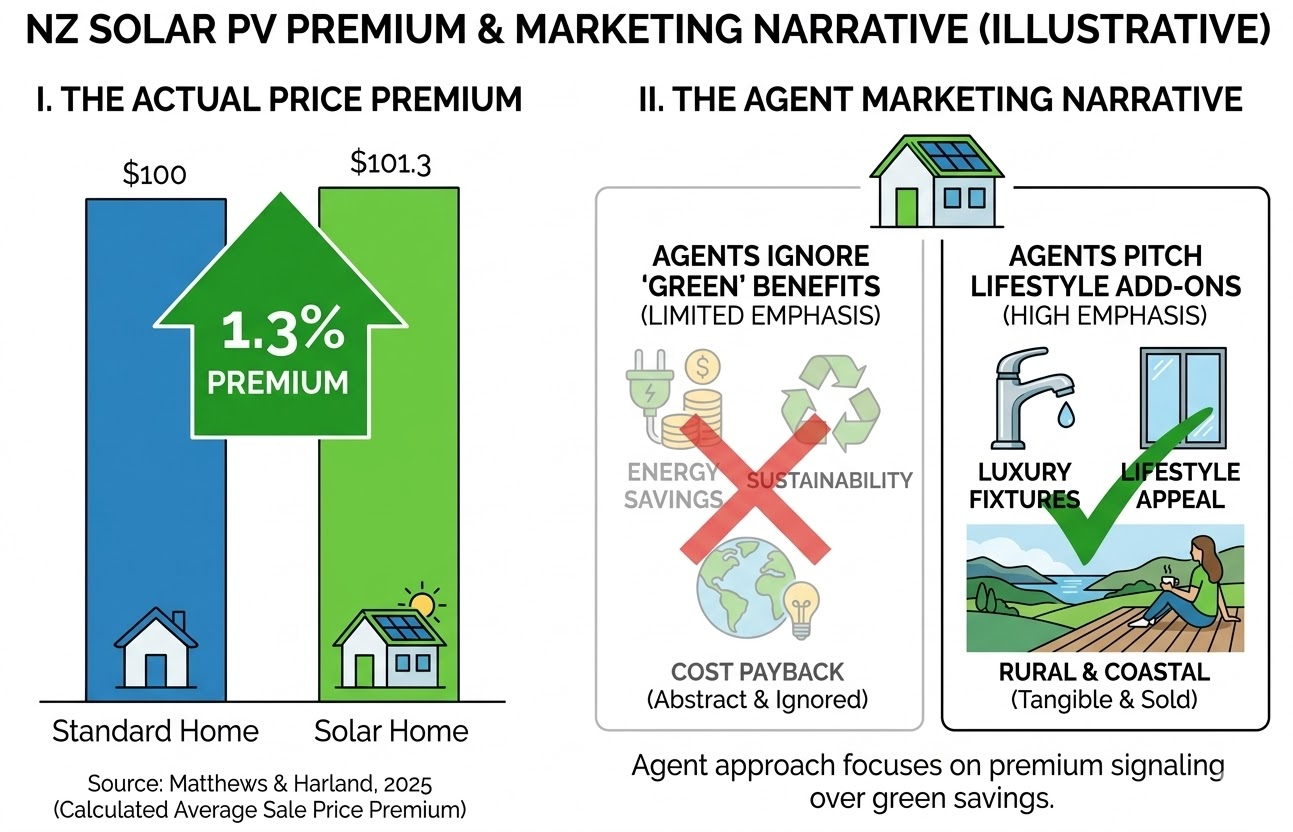
A new New Zealand study shows solar panels add a mere 1.3% premium to a house’s sale price, and real estate agents completely ignore the “green” benefits to sell them as luxury lifestyle add-ons instead. It’s a fascinating finding that perfectly illustrates what Dr Jess Berentson-Shaw from The Workshop has been telling the Passive House community: how we frame better buildings matters a whole lot more than the math.
The paper, Power in the pitch: narratives and market value of solar PV homes in New Zealand by Matthews and Harland, analysed nearly 80,000 property listings. The short answer is that sustainability framing is basically absent. Instead, solar is bundled with high-end fixtures, double glazing, and rural appeal. Because the long-term energy savings are abstract and hard to calculate, buyers rely on simple heuristics. Solar just becomes a signal for “premium.”
This data neatly intersects with the research from The Workshop on how Kiwis think about housing. Jess and her team warn that terms like “high performance” actively work against us because the public translates that to “unnecessary expensive luxury.” The solar study proves this is exactly what the real estate market is doing with anything above minimum standards.
If we want certified Passive House homes to become the norm we have to rethink our pitch. We need to stop leaning on complex operational cost paybacks that just trigger an unhelpful “housing as a financial asset” mindset. Instead, we need to make the benefits tangible. We aren’t selling a spreadsheet of U-values; we are selling a home you can rely on, a home that keeps your family healthy and warm all winter. A home that is a ridiculously good for your families long-term health.
Reference
Matthews, Y.S. and Harland, C.S. (2025). Power in the pitch: narratives and market value of solar PV homes in New Zealand. International Journal of Housing Markets and Analysis.
Abstract: Results show that solar homes are marketed through lifestyle, rural and quality cues rather than explicit sustainability framing, suggesting that PV is bundled with broader amenity signals rather than positioned as a distinct attribute. PV-equipped homes command an average sale price premium of 1.34%, with no significant difference in days on market. Effects do not vary with solar irradiance or local solar penetration, indicating limited salience of site-specific energy benefits in buyer decision making.