
I’ve just finished reading a new paper in the Journal of the Royal Society of New Zealand by Rochelle Ade, Mike Rehm, and Vishnupriya: “What is drier? Understanding humidity in green-certified dwellings.” It’s a solid piece of work focusing on 7-Homestar (v4) apartments for older residents in Auckland. You should definitely read the full open-access paper here. Really wish they had provided a scatter plot for the main apartment they focused on for temperature, RH and absolute humidity.
The paper suggests we might need to pivot our focus toward Absolute Humidity (AH) for health and viral transmission. While it’s great to have more data on Auckland apartments, I’m not convinced we need to redefine “drier.” In our climate, if you control Relative Humidity (RH) to avoid mould, you’ve already controlled the AH as a side effect.
The results are telling: during winter, these Homestar units spent about 90% of the time above the “optimal” 60% RH mark. One unit sat at 20°C and 75% RH for half the winter. At those levels, you aren’t just flirting with viral transmission; you are inviting mould to grow on the building fabric.
I was surprised the authors didn’t mention the Passive House limit of 12 g/kg Absolute Humidity. This is the Schwülegrenze (sultriness limit), where the human body can no longer evaporate sweat efficiently. It’s a physiological hard stop, not an arbitrary suggestion.
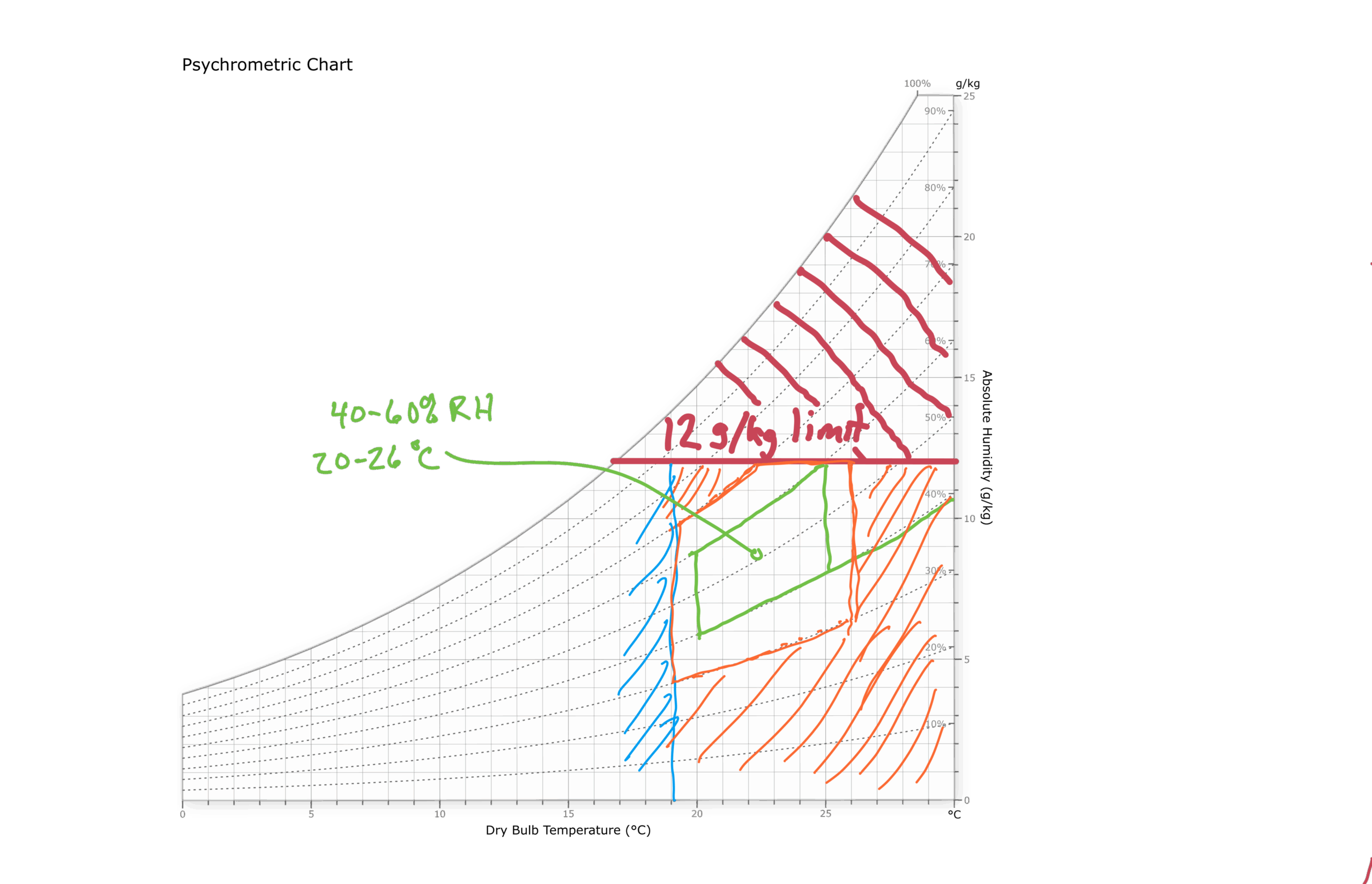
Plot the relative humidity versus temperature range and absolute humidity on a standard psychometric chart (REF https://andrewmarsh.com/software/psychro-chart-web/). You can see over the typical comfort temperature range and 40-60% RH the absolute humidity is pretty low this prioritizes surface mould control over viral control.
The bottom line? These v4 Homestar units (as far as I can tell) lacked continuous mechanical ventilation. In a damp Auckland winter, “drier” isn’t a new definition; it’s a result of basic building science. You must heat and ventilate continuously—ideally with an MVHR—to keep RH below 70% (as a practical limit ideally in the 40-60% range). If you aren’t willing to heat enough to move the RH needle, then you’d better be running a dehumidifier.
Abstract
This study evaluates the wintertime humidity performance of 40 subsidised, 7-Homestar (v4) certified apartments in Auckland, New Zealand. Findings show that while indoor relative humidity frequently exceeded the 40–60% range, absolute humidity remained within 8-14 g/kg. The research calls for a reassessment of how “dryness” is defined in green building tools, suggesting a focus on AH to better balance energy efficiency and occupant health.
Reference:
Ade, R., Rehm, M., & Vishnupriya, V. (2025). What is drier? Understanding humidity in green-certified dwellings: a winter case study from Auckland, New Zealand. Journal of the Royal Society of New Zealand, 55(6), 1959-1978. https://doi.org/10.1080/03036758.2025.2463450