
Failure to insulate MVHR fresh air intake and exhaust ducts, septic terminal vents, and rainwater pipes inside the thermal envelope is a recurring pitfall that can prevent Passive House certification. In conventional construction, these pipes are typically left uninsulated because the building’s overall energy inefficiency masks the heat loss. However, in a high-performance thermal envelope, these conduits carry outside conditions directly into the conditioned space. Without proper insulation, they become significant thermal bridges that cause substantial energy losses and create a high risk of surface condensation and mould growth.
While New Zealand and Australian building codes are not explicit on these requirements, international standards such as DIN 1986-100 (Clause 6.3.3) are clear: internal wastewater and rainwater pipes must be insulated against Schwitzwasser (condensation) if building conditions require it. Locally, Marley NZ also explicitly recommends insulation for pipes carrying cold fluids or air through warm spaces to prevent “dew condensation.”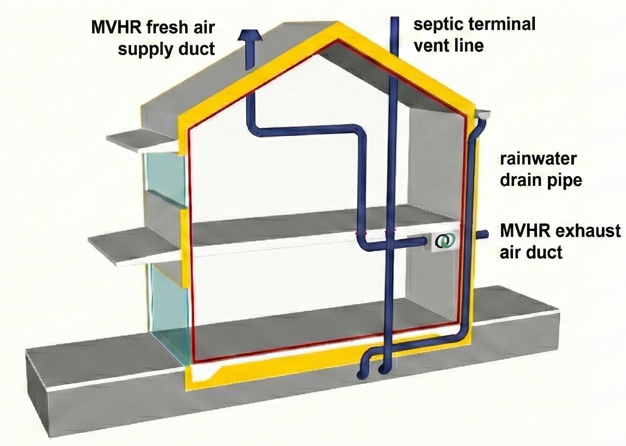
Figure showing MVHR fresh air intake and exhaust ducts plus the septic terminal vent inside the thermal envelope and air control layer (red line). These need to be insulated with vapour tight insulation. The rainwater pipe shown is outside the air control layer and may impact energy as it is in the insulation layer but is not a moisture concern as it is outside of the air control layer.
The impact of outside conditions
MVHR fresh air supply and exhaust ducts, septic terminal vent pipes, and internal rainwater drains contain air at ambient outdoor temperatures. In winter, these cold surfaces are exposed to warm, relatively humid indoor air. Without vapour-tight insulation, an uninsulated pipe acts as a “cold finger.” This becomes a primary site for energy loss and high relative humidity, creating health risks from mould long before it is visible to occupants.
Energy losses and thermal bridging
Uninsulated vent lines and ducts contribute significantly to the total heating demand of a building. In smaller Passive House projects, an uninsulated septic vent stack running through the thermal envelope can account for nearly 10% of the entire heating budget. This is often enough to push a project over the 15 kWh/m²a limit required for certification.
Managing condensation risk with the fRSI factor
The hygiene requirement in Passive House design ensures that surface temperatures remain high enough to prevent mould growth. This is calculated using the fRSI (temperature factor). For example, a project in a cold climate like Queenstown may require an fRSI>0.42 to maintain healthy conditions. [This specific value is climate-dependent; designers must calculate the required fRSI based on local climate data in the PHPP.]
Achieving the required surface temperature typically involves vapour-tight insulation, such as 13mm Armaflex or similar. This is usually sufficient to meet the fRSI requirements, though the Passive House designer must verify that this insulation also satisfies the overall energy demand within the PHPP.
Practical challenges for builders
A common issue arises during construction when standard 90mm plumbing walls are used. These narrow cavities often lack the space required for both the pipe and the necessary thickness of insulation. As an example if you design with 50mm of insulation on an 80mm septic terminal vent stack that’s 180mm thick (i.e. 80mm pipe plus 50mm on the radius or 100mm on the diameter insulation) and won’t fit in most walls. Similarly, cavities for MVHR ducts need sufficient space for both the ductwork and the wrap. If this is not addressed during the design phase, builders may be forced to retrofit insulation in finished walls or ceilings—an expensive and invasive process. Successful Passive House projects require early coordination to ensure service cavities are sized to accommodate ductwork and insulation together.