
Clients and engineers need to be confident in the results of their building models. Key to this confidence is not the arrogance of simply trusting the default outputs of a software tool, but the ability to rigorously cross-check results across different platforms and against real-world, built projects. Recently, we cross-checked a dynamic hourly model built in EnergyPlus using the DesignBuilder GUI against a Passive House Planning Package (PHPP) model. The initial comparison revealed an alarming deviation of approximately 60% in annual heating demand.
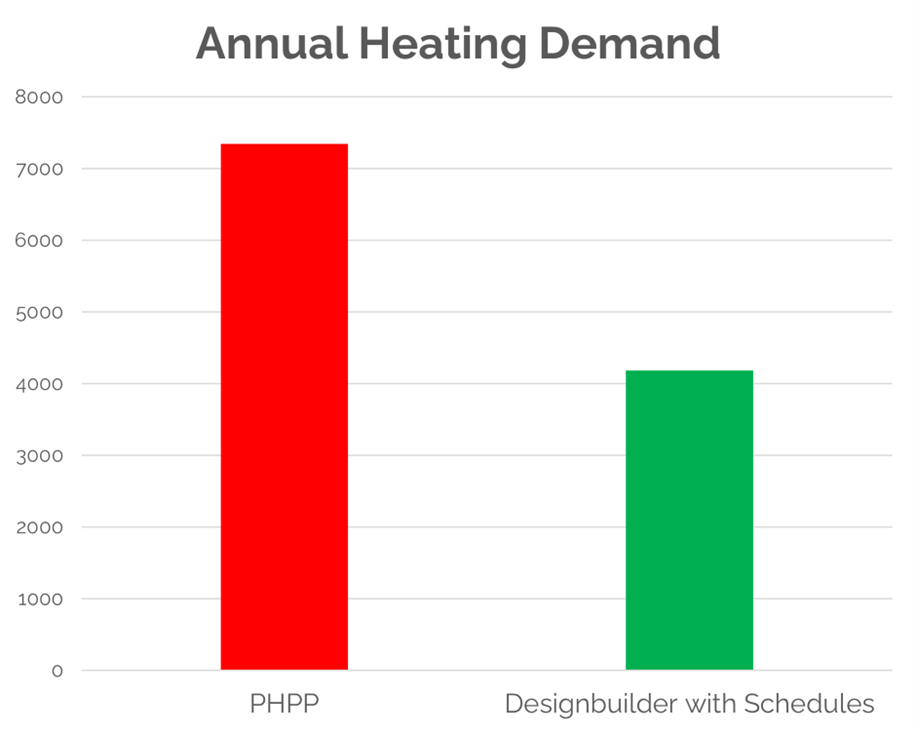
Explaining the 60% heating demand gap
In the world of building science, a 60% gap between expectation and reality usually indicates a massive mistake. However, going back to first principles revealed that neither model was inherently wrong; they were simply answering two different questions.
The primary reason for the large discrepancy came down to internal load schedules. PHPP is an annual energy balance tool built for certification, and it assumes the building must remain comfortable and conditioned between 20°C and 25°C all year round. It does not factor in whether occupants are at work or on holiday; building hygiene and continuous comfort remain the priority. Conversely, EnergyPlus, by default, often follows occupant schedules. In many standard setups, if the building is empty, the heating is turned off.
A model simulating a building that is only conditioned for eight hours a day will understandably show a much lower energy demand than a PHPP model demanding comfort all day, every day. To test this, the EnergyPlus model was forced to run its HVAC systems 24/7 to match the PHPP methodology. Once corrected for these schedule differences, the gap almost entirely disappeared. The numbers are rarely identical due to different mathematical handling of solar gains and thermal mass, but they landed firmly in the same ballpark. This confirms the science holds up and provides confidence that both models are working correctly.
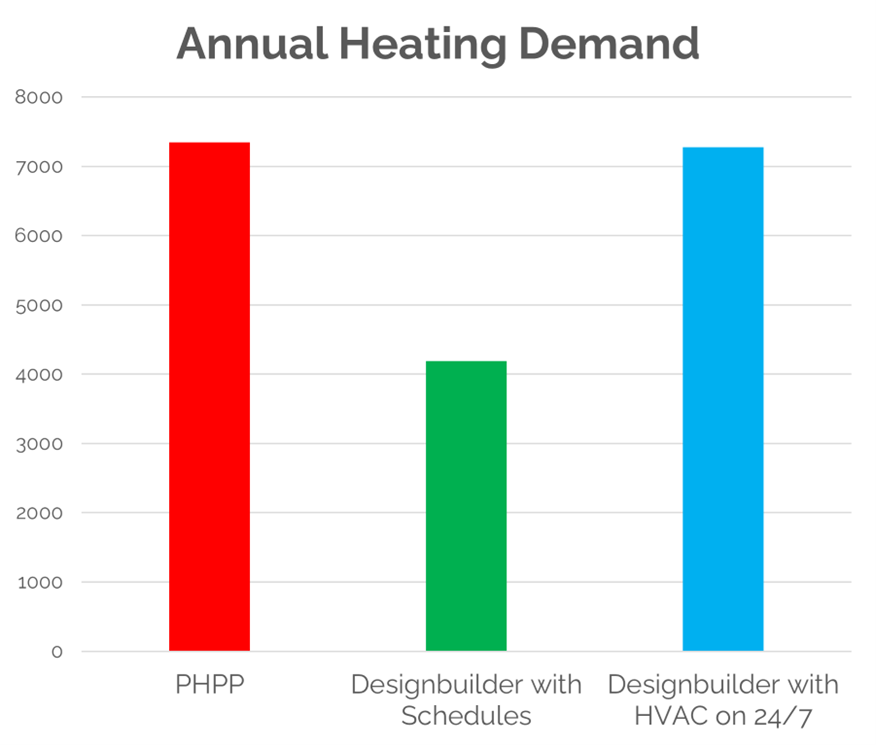
The necessity of multi-zone dynamic modeling for cooling
This rigorous cross-checking is even more critical when moving beyond annual heating demands into complex territory like summer cooling. Relying on single-zone averages can mask significant issues. Research indicates that air conditioners sized according to default PHPP single-zone cooling load numbers might only possess 10% to 27% of the capacity needed to meet the actual building cooling load, depending on the climate and building typology. You can read more about this research and how to adjust the models here.
Hard-won knowledge dictates that a multi-zone dynamic thermal modeling is required to accurately capture peak zonal cooling loads (and sometimes a single zone PHPP model can be adjusted to work well enough). Whole-house averages easily disguise severe localized heat peaks, particularly when unshaded east or west glazing allows low-angle sun to penetrate deep into specific rooms at the beginning and end of the day. Understanding these zonal dynamics allows engineers to make informed decisions about cooling system design, equipment sizing, and external shading.
The value of expert cross-checking
Both tools are excellent, provided you understand the differences you are working with. Trusting the first result from a complex model without asking what level of confidence supports it is a risk. The ability to quickly cross-check results across tools, and against tested post-construction heat loads, is what assures accurate building performance and protects the client’s investment. Always check the assumptions; don’t blindly trust an energy modeling tool.