
I tackled the intimate relationship between ventilation and internal moisture (sections G4 and E3 of the NZ Building Code) in a masterclass I recently presented as part of Pro Clima’s 2025 Knowledge Zone series. The goal was to challenge faulty assumptions that create damp, unhealthy buildings. We must look beyond simple Code compliance, because ventilation without adequate heating is ineffective at controlling interior moisture.
Other key themes included the failure of current performance models, the physics of relative humidity and the necessity of treating heating and ventilation as an integrated system in order to create genuinely healthy and dry homes.
I was heartened by the very large turnout and the questions received. Let’s make better design choices and create healthier and more durable buildings!
You can’t solve E3 with G4 alone
This was the core idea I wanted to convey. The notion that just punching enough holes in a building fabric for ventilation will solve moisture problems is a dangerously flawed approach. Frankly, relying on the G4 calculation method to solve internal moisture is, frankly, designing for failure. It assumes occupants will perfectly ventilate their homes in winter, which is a fantasy.
The science is simple: cold air can’t hold much moisture. Ventilating a cold house with cold winter air does next to nothing to remove the internal moisture generated by living. To actually dry a building, you have to heat the air. Warm air acts like a sponge, soaking up the moisture which can then be removed by extracting by a functioning ventilation system. Without heating, ventilation is just a pointless, drafty exercise.
Our compliance models are a tragedy
Our current regulatory system encourages a box ticking mentality. But box-ticking for G4 and E3 compliance often involves performance models that have only slight correspondence with reality. We are building tragedies into our homes because our performance models ignore the fundamental laws of physics and human behaviour.
We model for compliance, not for actual performance. We assume windows are opened because the Code says we can, ignoring the reality that without adequate, affordable heating, people will seal their homes up tight in winter to preserve what little warmth they have. The model says the house is dry; the reality is condensation running down the walls and mould growing in the closets.
Stop choosing between heating and ventilation
The entire debate is framed incorrectly. It’s not a choice between heating or ventilation. They are two halves of the same system. Stop treating ventilation as a cheap substitute for a good thermal envelope and an efficient heating system. Both are needed. Anything less is compromising the health of the occupants.
The only robust solution is to design and build homes with continuous mechanical ventilation running at a high enough rate for the occupancy and climate and then to heat those buildings. It’s time we stopped hiding behind compliance documents and started designing for the real world.
Resources
Available to watch online: G4 & E3: The Critical Relationship Between Heating, Ventilation, and Healthier Homes
The slide deck can be downloaded here.
Following are links to the helpful resources noted in the presentation, listed by topic.
Ventilation
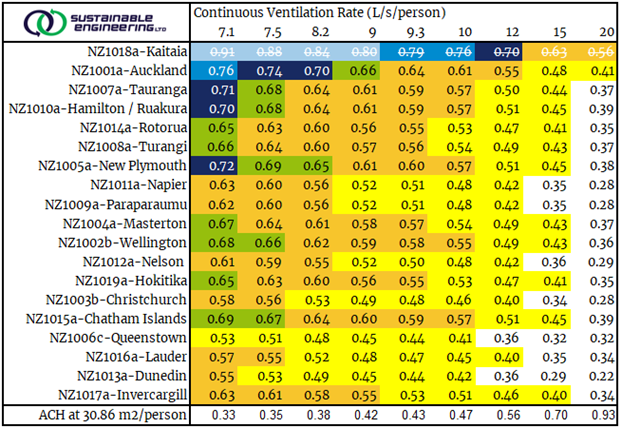
Table of fRSI on a surface for New Zealand climate zones with different ventilation rates.
Healthy Buildings
Dehumidifiers
BRANZ Reports