
AeroBarrier, an automated air sealing technology imported from the United States, is now available in New Zealand and will soon launch in Australia. It utilizes aerosol sprayers to distribute a specialized sealant into a home while the space is simultaneously pressurized by a blower door fan (see below). The pressure forces the aerosolized particles into cracks in the air control layer, continuously sealing gaps until the airtightness target is reached. This allows builders to achieve very low ACHn50 targets with significantly less stress, relying on the technology to do the heavy lifting.
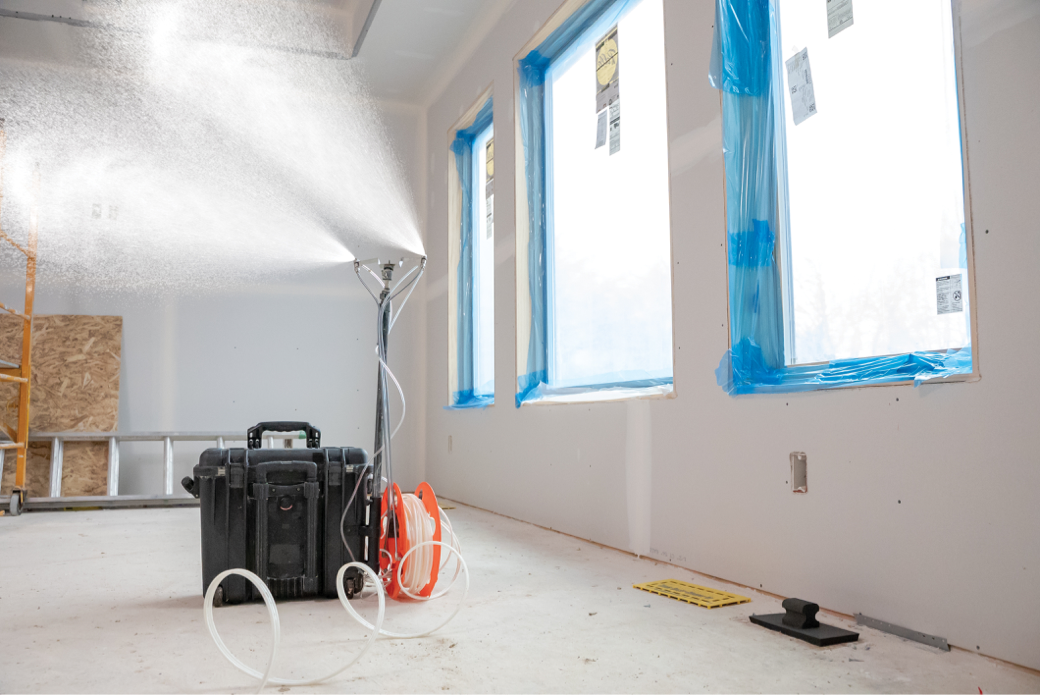
Photo of AeroBarrier sprayer in operation. Notice the taped up window recess and frames.
Achieving rigorous airtightness is akin to wrapping a Christmas present: simple boxes are easy, but complex shapes require far more work and tape. Traditionally, Passive House design relies on specialist membranes or sheet goods, such as plywood in a service cavity, combined with airtightness tapes. These trusted methods have decades of use in New Zealand behind them. While minor field degradation can occasionally occur—such as tape fishmouths opening up, repeat testing of the same building after 4 years (here in NZ and 25 years in Germany) shows that the airtightness of a taped building can remain constant with time. AeroBarrier provides an alternative by automatically filling gaps around tricky junctions, such as electrical outlets, without manual taping.
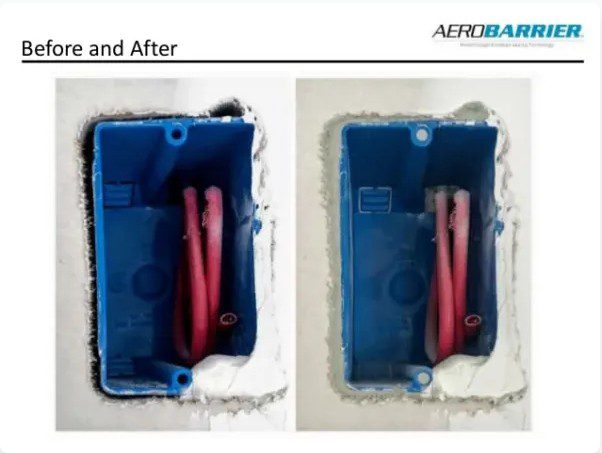
Photo of an electrical outlet showing what the AeroBarrier looks like in the gap (the grey stuff).
While using AeroBarrier can simplify the physical work, it does mean that often the gypsum wall and ceiling board becomes the primary air control layer, unless there is another air control layer designed into the building assembly. A vulnerability here is that this layer is not protected from building occupants, who might unknowingly puncture it. In the USA, one approach has been to use a rigid air barrier (RAB) on the outside of the home, and AeroBarrier is used before the insulation is installed. This produces an air control layer on the outside of the insulation, which safely protects it from occupants. The choice of AeroBarrier simplifies construction and achieving airtightness, but it still requires understanding how this fits into the overall design and construction sequence.
A common concern regarding new sealing technologies is long-term durability. AeroBarrier has assessed their sealant across three primary factors: flexing, aging, and material compatibility. To test flexing, the material was applied to a 3 mm wood joint and cycled fifty times through extreme climatic temperatures (-34°C to 82°C) to force 20% expansion and contraction, simulating worst-case joint movement over 50 years. To simulate chemical degradation over that same period, testing utilized an Arrhenius relationship, extending the duration of the 82°C high-temperature cycles to accelerate aging. Following this rigorous conditioning, the sealant showed no evidence of cracking, crazing, or spalling, and maintained 0.13% leakage compared to an open joint. See their data sheet here: https://aero.solutions/wp-content/uploads/2026/09/AeroBarrier-Durability-Test-Data.pdf
Accelerated aging tests for building materials typically rely on elevated temperatures and controlled humidity to compress decades of wear into a few weeks. For comparison, Pro Clima evaluates the durability of their airtightness tapes at the University of Kassel using the DIN 4108-11 standard, which subjects adhesive joints to 65°C and 80% relative humidity. While 120 days under these demanding conditions simulates approximately 17 years of real-world aging, Pro Clima increased their test period to 700 days to successfully confirm a 100-year service life. Both methods effectively use high heat to accelerate chemical degradation.
Testing material compatibility is equally critical. For AeroBarrier, the sealant was applied to 41 different common building materials and conditioned in a warm, humid environment (120% relative humidity) for 10 days. Following this exposure, magnified inspections confirmed no discoloration or material breakdown at the sealant-substrate interfaces. It should be noted that substrate compatibility is still an issue across adhesives, and this testing is indicative. Because site conditions and materials vary widely neither the manufacturer nor the independent tester assumes liability for the accuracy or reliability of data associated with particular uses.
Another concern I’ve heard is about offgassing of the sealant. AeroBarrier sealant is UL GREENGUARD Gold Certified. This means that it has ultra-low VOCs, and AeroBarrier claims the sealant is completely inert once applied, with no off-gassing.
So.. What do I think
For typical New Zealand and Australian homes, air leakage is a significant issue, and standard code minimum designs rarely include any specific air control strategy. In these cases, AeroBarrier can be a great fit. It reduces air leakage, which is critical to durability for building assemblies, especially for ceilings where escaping air causes the majority of moisture issues.
In high-performance homes like Passive House, which are purposefully designed with air control layers, AeroBarrier is a design choice. If your assemblies are designed to use AeroBarrier to form an air control layer at the correct location and protected from occupants, this looks to be a good solution. For example, if you used plywood, gypsum board, or SIPs as your air control layer with a service cavity, AeroBarrier could replace the use of tape in this layer. The labor savings may make this economically viable, and the durability judging from this provided test data appears sufficient. Additionally, if a Passive House fails the blower door test, it is incredibly useful to be able to call and have AeroBarrier installed rather than having to rip apart building assemblies or accept the failure.
One item of consideration for the industry is that airtightness testing is often a proxy for building quality. You won’t achieve a good blower door test result unless the builders are paying close attention to detail. AeroBarrier, due to its automation, removes the ability to use airtightness as a proxy for that overarching quality.
Images with permission from Aero Solutions.