
There is a myth in the construction industry that thin “insulating” paints or foils can replace traditional bulk insulation. The short answer is that while these coatings do work, they rarely function for the reasons advertised. A coating that is less than a millimetre thick cannot provide a significant barrier to conductive heat flow. However, these materials can drastically alter surface absorptivity and emissivity, which significantly impacts radiation heat transfer. Heat flux across air cavities in buildings is typically dominated by radiation, which can account for 65% to 80% of the total energy exchange. To use these products effectively, designers must look past the marketing hype and understand the physics of radiation control.
The physics of heat flux: conduction vs radiation
To understand why a thin coating or foils cannot replace thick bulk insulation, it is important to distinguish between how heat moves. Traditional bulk insulation works like a blanket: it resists heat flow through low thermal conductivity and material mass. It physically slows the transfer of energy.
Reflective insulation and coatings operate on a completely different principle. They manipulate the surface properties to either reflect heat radiation or minimize the energy emitted from the warm side of a wall. The performance of these systems relies entirely on maintaining low surface emittance. Dust accumulation, moisture induced condensation, and chemical oxidation can degrade the low absorptivity or emissivity coating performance over time.
Three things to know about a surface
When looking at a surface coating for thermal performance, three specific physical properties matter:
- Emissivity: How efficiently a surface emits heat. A low emissivity (low e) surface radiates very little energy.
- Absorptivity: How much solar radiation (sunlight) the surface soaks up.
- Thermal conductivity: The rate at which heat passes through the material itself. This is a function of the thickness and is measured in W/(mK)
Why coatings fail as thermal breaks
Marketing materials often suggest that spraying a thin layer of coating on a steel beam acts as a thermal break. The physics suggests otherwise. Take a representative product, such as AEROLON® ACRYLIC spray.
From the data sheet, the thermal conductivity of this product is 0.035 W/(mK) with a recommended thickness for use as a thermal break of 2000 microns, or 2mm. Using the standard formula for thermal resistance (R = thickness / conductivity), the conductive insulation benefit is:
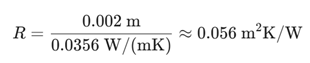
This results in a conductive heat transfer benefit of roughly R0.06. In high performance building assemblies this is almost negligible. For comparison, typical surface air films used in Passive House modelling are around R0.13 for internal wall surfaces and R0.04 for external surfaces. The coating itself offers resistance comparable to the thin layer of outdoor air.
Consequently, the only place this type of coating makes sense as a thermal break is in warm to hot climates where it simply does not get that cold. In a temperate or cool climate, if the goal is to reduce thermal bridging on steel, boxing around the steel on the outside of the thermal envelope with bulk insulation is a far more effective solution.
Where coatings shine: cooling and solar control
While they are poor insulators, coatings are exceptionally good at rejecting heat from radiation – like the sun. If the design goal is to keep a building cool, surface absorptivity becomes the critical number. Specifically, designers must look for the weathered surface absorptivity after 3 years of exposure.
For standard materials, absorptivity is easy to estimate from colour: dark colours absorb heaps of solar energy, while lighter colours absorb less. However, technology has introduced “cool colour” paints. These coatings are engineered to have low absorptivity outside the visible spectrum. This allows a roof or wall to appear dark to the human eye while reflecting the invisible infrared wavelengths that carry much of the sun’s heat.
This property is so vital for overheating protection that the Passive House Institute (PHI) explicitly regulates it. The “2.2.1 EnerPHit criteria for the building component method” requires cool colours for hot and very hot climates. Note that this is a hard requirement only for the EnerPHit Component Method. Other certification tracks, such as the full Passive House Standard, simply require that the specific weathered absorptivity after 3 years of exposure, emissivity, and thermal conductivity be accurately modelled in the Passive House Planning Package (PHPP).
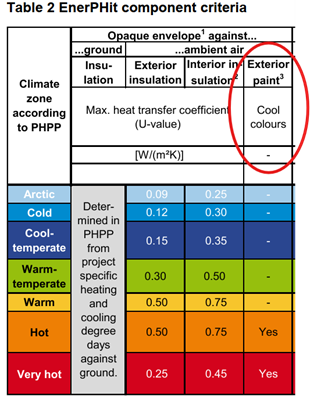
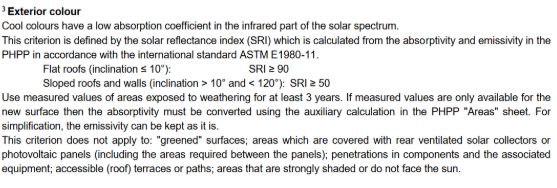
Excerpt from the Passive House Institute Certification Criteria, Version 10c.
Speaking of EnerPHit: Retrofitting is much harder than building new because you have to diagnose the patient before you cure them. If you get the physics wrong especially with internal insulation you risk rotting the framing out from under the new+ lining.
If you want to avoid those expensive disasters, we are running our Retrofit Expert course starting February 24, 2026. It is designed specifically for NZ and Australian climates, covering everything from the “4 Control Layers” to advanced hygrothermal analysis.
Master the art of the retrofit here: sustainableengineering.co.nz/retrofitexpert
The double edged sword: night sky cooling and condensation
For cooling purposes, high emissivity is generally good because it allows the building to radiate heat away. However, surfaces with high emissivity radiate energy efficiently to the night sky. On clear nights, this radiative cooling can cause the roof surface temperature to drop below the air temperature. If the surface drops below the dew point, condensation forms.
Consider a galvanized steel roof versus a painted steel roof. Plain galvanized steel has a relatively low emissivity (weathered) of around 0.6. Painted steel usually has a high emissivity of around 0.9.
This leads to a result where painting a galvanized steel roof can actually cause condensation problems in the attic space below. The painted surface cools more, increasing the condensation load. Crazy stuff happens in the real world when a single variable is changed in a complex assembly.
Luckily this effect is not large and there is usually enough drying capacity and drainage in roof assemblies that this doesn’t cause issues.
What about low absorptivity paint on roofs?
Low absorptivity paint can reduce building cooling loads because it significantly lowers the roof surface temperature (and heat gain into the building). However, in building science, there is no such thing as a free lunch.
In cooler climates—essentially anything outside the ‘Hot’ or ‘Very Hot’ categories—solar heat plays a vital role in the durability of the roof assembly. Heat drives drying. By reflecting that solar energy away, the roof stays cooler, which directly reduces its drying potential. By switching to a low absorptivity paint, that safety margin is removed. The result can be moisture accumulation in a roof that previously worked fine. Saving energy on cooling is not ‘free’ if it comes at the cost of the building’s durability.
Internal applications and the “magic” paint
Can these coatings be used indoors? I’ve seen marketing for low emissivity internal paints designed to reflect heat back into the room. Again, yes they can work this way but the effect is small.
The principle is similar to low e glazing. If a low e coating is placed on the room side of a single pane of glass, it increases the R-value. However, this performance comes at a cost: the glass itself becomes colder. If condensation forms—even just a thin film of fog the low e properties are instantly gone until the window is dry.
The same logic applies to internal walls, floors, and roofs. If a coating lowers the internal surface emissivity from the typical 0.9 down to 0.6, the physics of the room change. The indoor mean radiant temperature increases by approximately 0.5°C, and the operative temperature by approximately 0.3°C (Fantucci 2020).
In PHPP, this effect can easily be modelled by adjusting the internal surface film coefficient. In a best case scenario, this might increase the internal surface film coefficient from R0.13 to R0.26. While this is a 100% improvement in the film coefficient, it is a minor change for the total assembly. For a typical Passive House wall with a total R-value of R4.0, adding R0.13 is only a 3% improvement.
A warning for Certification:
Designers attempting to claim this internal low emissivity coating benefit must be careful.
- Certification Agreement: You must point out this change to the Certifier. It requires a deviation from standard U-value calculation sheets, and the Certifier must specifically agree to the custom value. (Please point it out. We’re human and might miss it otherwise as it’s not a variable we see changed often.)
- The Human Factor: The performance relies entirely on the specific finish of the paint. If the homeowners repaint their living room five years later with standard interior acrylic, the low e property is lost. If that specific performance gain was required to meet the Passive House criteria, the building is technically no longer a Passive House.
Conclusion
Thin coatings are not a substitute for insulation. They cannot stop conductive heat loss in the way that typical bulk fibre or rigid insulation can. However, they are powerful tools for managing radiation. Whether it is rejecting solar gain in a hot climate or marginally improving internal comfort through reflection, they have a place in the building science toolkit.
Designers must ignore the “insulation” marketing claims and focus on the radiative properties. Use them to lower cooling loads, but be wary of condensation risks on roofs. As with all things in Passive House design: calculate the specific impact, verify the physics, and ensure the solution fits the climate.
Reference: Fantucci S, Serra V. Experimental Assessment of the Effects of Low Emissivity Paints as Interior Radiation Control Coatings. Applied Sciences. 2020; 10(3):842. https://doi.org/10.3390/app10030842