
It’s commonplace for New Zealand Passive House homes to have garages that, while attached and with internal access, sit outside of the house’s thermal envelope. Designed well, this unconditioned space can provide various benefits, such as shading from western sun and thermal insulation. The door between the garage and the house does not necessarily have to be a Passive House-certified component. Passive House designers sometimes want to use a standard timber fire door or threshold to the attached garage for the sake of simplicity, cost … or usually just availability.
This can work from an airtightness point of view. In many New Zealand climates it can also be alright from an energy efficiency point of view. But what about the risk of mould, as predicted by the fRSI target that must be met for Passive House certification? Depending on exactly how the seals and the threshold are designed (air gaps and seal locations matter a lot!) the fRSI can be surprisingly poor. But the door is to the garage not to the outside and that does make it easier to meet the fRSI. Below we detail one approach our team has used to calculate the benefit of the garage without using a Flixo model.
As an example, the drawing below shows a door frame with a very poor fRSI of 0.27. The surface film resistance on the exterior is Rse=0.04 m²K/W and the surface film resistance on the interior is Rsi=0.25 m²K/W: these are defined in the engineering standards from ISO6946 and PHI certification.
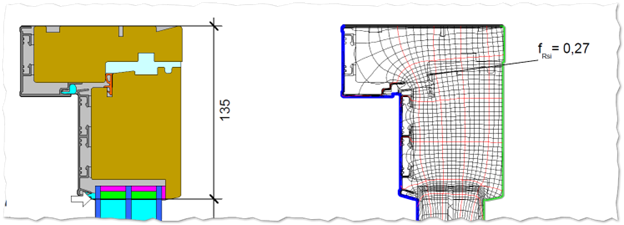
Fig 1. Example door frame with poor fRSI. Source: Sustainable Engineering
This article explains how to calculate the fRSI value for a door where it opens to a garage rather than the outdoors. The first step is estimating the benefit of the garage. ISO6946 has a calculation method for doing this, which we already explained in detail, so read that first.
The Ru value calculated according to that article replaces the Rse=0.04 m²K/W part of the formula. The Ru value will be more than R0.17 and is commonly R0.4 in a well-insulated but unconditioned garage. Simply use R0.17 in place of the typical R0.04 in your Flixo model, if the project can afford a conservative value.
Otherwise, calculate a more precise value. In the example below, we’ll use Ru = 0.4 m²K/W. The best option is to re-run the 2D finite element model (either Flixo or THERM) model with the Ru value replacing the Rse=0.04 m²K/W. This will give you the exact improved fRSI value.If you don’t have the Flixo model (not uncommon if the fRSI is from a PHI data sheet), estimate the fRSI by solving for the original frame resistances and then changing the Rse to the Ru value. The engineering equivalence for the frame calculation above is three resistors in series.
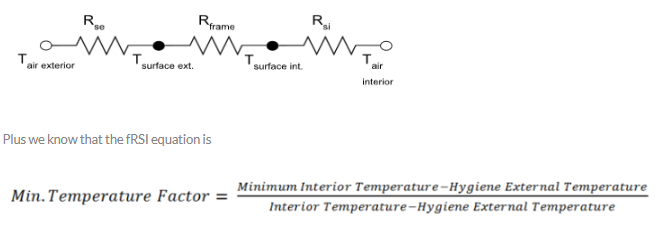
We can use 0°C and 20°C as the air temperatures exterior and interior (ie hygiene external temperature = 0°C) and thus for this particular frame, the minimum interior temperature is 20°C x 0.27 = 5.4°C
Rframe= 0.052 m²K/W
Now we can change the Rse to the Ru and solve for the new Tsurface int.
Tsurface int. = 12.9°C and the fRSIgarage door = 0.64
This of course depends entirely on the Ru value.
If you’d like a maths refresher, here is a summary for solving for resistors in series from a high school physics class. You’re welcome!