
We are entering a critical phase for high-performance housing in New Zealand and Australia, specifically regarding our existing building stock. To support this, Jason Quinn will host a Retrofit Expert course in February 2026. This four-week live online course—the first of its kind for our region—will cover essential strategies for trades and designers looking to master the complexity of deep retrofits. More information here.
Whether tackling a complex retrofit or a new build, access to accurate, design-specific data is fundamental to success. This brings us to a significant new resource for Passive House designers: the MEPS tool.
The challenge: Data gaps in PHPP
Passive House Planning Package (PHPP) is a design tool intended to accurately predict reality. However, modeling heat pumps in PHPP has long been a source of frustration for designers in New Zealand and Australia.
To sell a heat pump in our New Zealand and Australian market, manufacturers must submit data to the MEPS (Minimum Energy Performance Standards) database. While this public database is extensive, extracting usable data for PHPP is difficult. Using the “standard” heat pump in PHPP 10 is not permitted for certification because it auto-sizes the unit, often yielding an artificially high COP. Furthermore, the official PHI heat pump tool does not align with the specific software and coolant load configurations used in units shipped to our region.
The solution: A dedicated MEPS tool
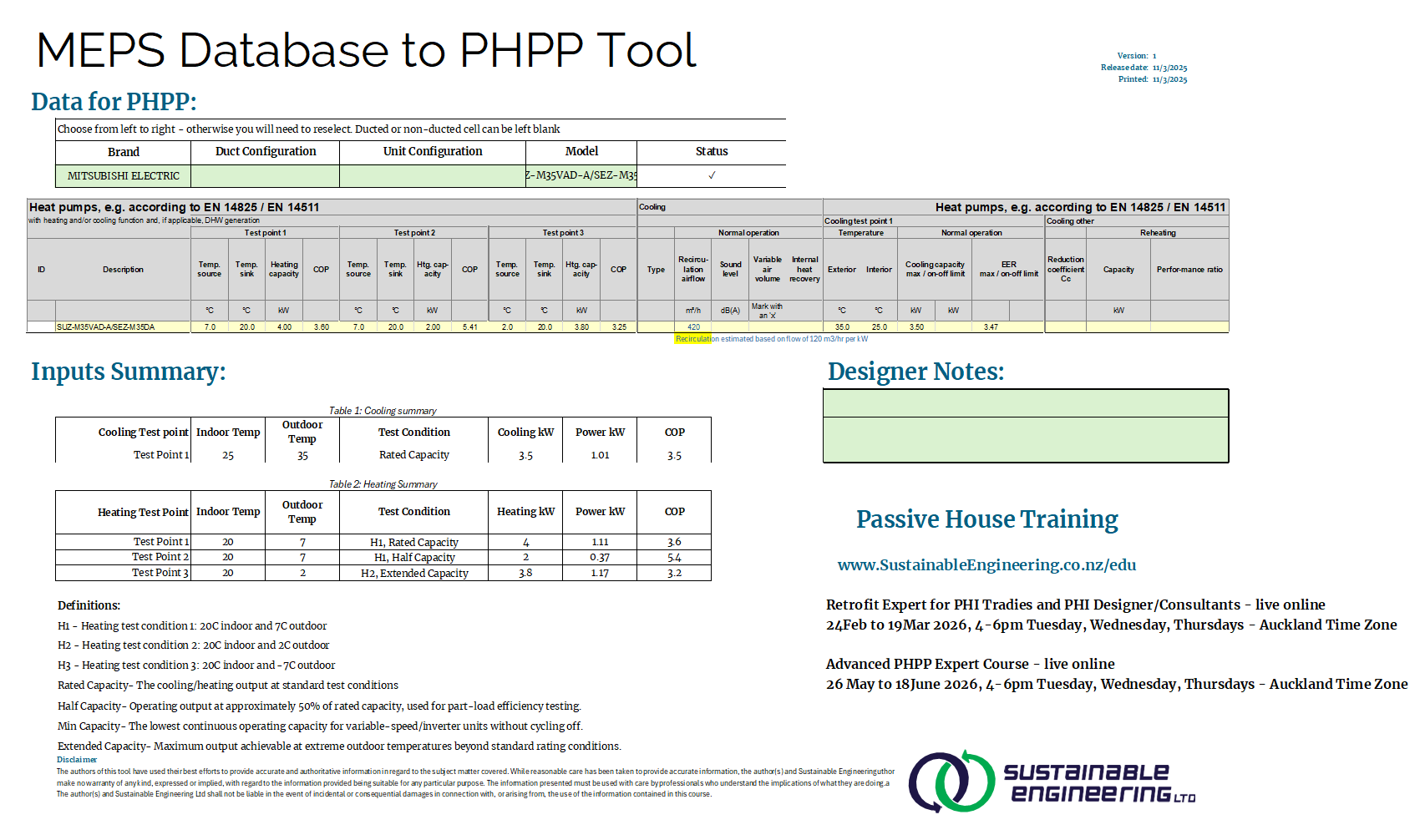
To bridge this gap, Sustainable Engineering has released a free MEPS tool. It mines the public MEPS database, which contains over 3,600 heat pumps available in New Zealand and Australia, and filters them for PHPP suitability.
The tool is designed to be a “duct tape” solution: pragmatic, functional, and efficient. It automatically identifies systems that have sufficient testing data—specifically, at least three heating test points and one cooling test point—to meet PHPP certification standards.
Scope and limitations
It is important to note that the MEPS tool is strictly for air-to-air split heat pump systems.
It does not cover air-to-water heat pump systems, such as those used for domestic hot water heating or hydronic radiators. That is still a data set we need to address as an industry. Currently, designers must continue to source reliable, discrete data for air-to-water units manually to ensure accurate modeling.
Additionally, the tool has specific software requirements:
- It requires Excel 2021 or later.
- It does not currently function on Excel for Mac.
How to use the tool
The workflow is designed to be fast:
- Select the unit: Open the Excel tool and select the brand and specific model from the dropdown lists.
- Verify the data: Check the data makes sense. Our near term plan is to add a plot where the tool shows the data points visually, integrating our separate HP data check tool, allowing for a quick sanity check.
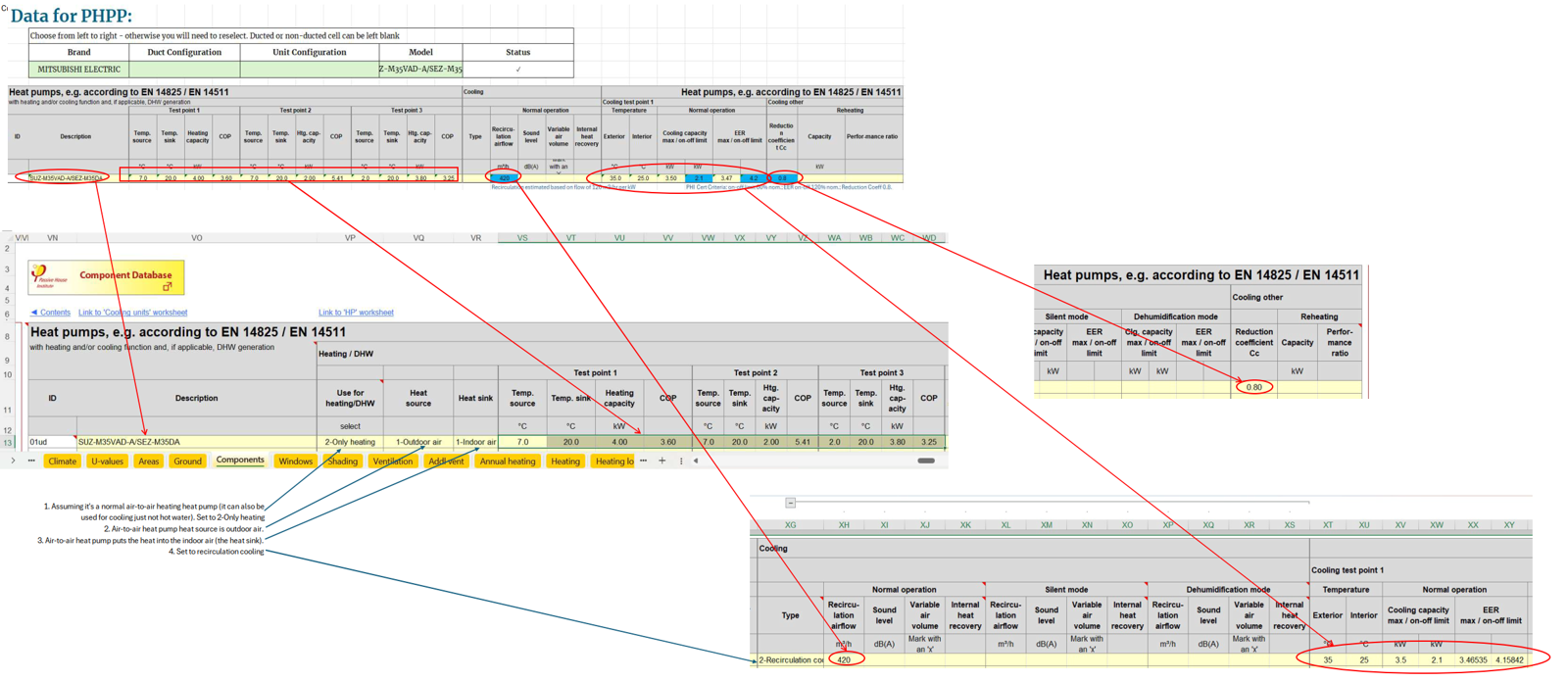
- Transfer to PHPP: Copy the formatted data directly into the PHPP ‘Heat Pumps’ sheet under the section Heat pumps according to EN 14825. The image below is full size in the MEPS tool on the instruction page. Follow the pictorial directions please.
Certify: Print the tool’s output page to PDF. This document serves as the verification which we will accept for certification submission. Other Certifiers may choose to accept this as well (but they don’t have too).
Next steps
You can download the MEPS tool for free from the Sustainable Engineering website. Please share the link rather than the file itself to ensure colleagues always access the latest version.