
As more Passivhaus developments are designed, centralising the hot water system across the development offers meaningful capital-cost savings. A single plant, sized for the development rather than duplicated dwelling-by-dwelling, reduces equipment, plant-room footprint, and per-unit installation costs. The same configuration makes it easier to specify a high-performance heat pump at scale. Two New Zealand developments the Leith Street Apartments in Dunedin and the Dunedin City Council Community Housing development are already built and certified to use centralized heat pump hot water systems.
The centralized system does save on capital costs but is it energy efficient? The question is whether the distribution network, and the associated losses, that links the central plant to each dwelling can deliver the savings it promises or quietly erase them.
Distribution losses in circulated hot water systems are easy to underestimate. For poorly insulated pipework or poorly executed junctions, the heat lost from the loop can be large enough to make the centralised heat pump operate at a fraction of its nameplate efficiency. In the worst case, the system performs no better than and may even underperform individual electric resistance hot-water tanks in each apartment, despite the heat pump’s nominal coefficient of performance advantage. The COP benefit, in other words, can be entirely consumed by the distribution network.
The losses from the distribution loop are straightforward to quantify once the per-metre heat-loss rate of the pipework is known. This is expressed as a psi value in W/(mK), and is calculated for the running temperature of the loop and the ambient temperature along the pipe route (ground temperature for buried pipe, internal temperature for above-ground). Multiplying the psi value by the loop length and the temperature differential gives the heat lost from the distribution network per unit time.
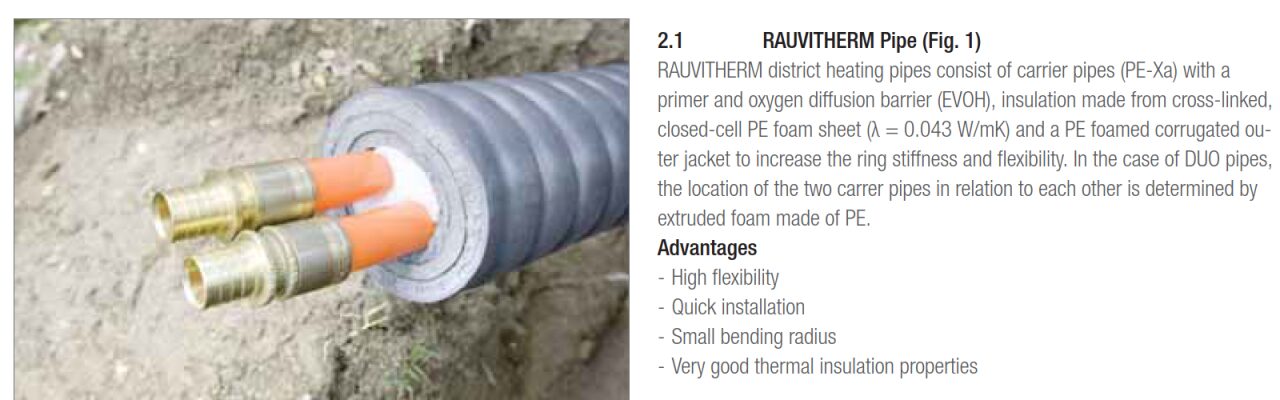
Pre-insulated pipework designed for district heating applications makes this calculation straightforward. The REHAU RAUVITHERM system a PE-Xa carrier pipe with an EVOH oxygen diffusion barrier, PE foam insulation, and a corrugated PE outer jacket is a representative example. Across the UNO and DUO pipe variants, psi values range from 0.1 W/(m·K) to 0.3 W/(m·K).
The advice from the Passive House Institute (PHI) recommends that distribution losses should account for less than 10% of the total heating network capacity used across the year. This rule of thumb keeps the system honest. If losses exceed this proportion, the case for centralisation is no longer straightforward.
The right piping system depends on the development topology. For buried distribution across a site between detached or semi-detached dwellings, for instance pre-insulated pipework such as RAUVITHERM is the standard solution. Its flexibility, modest bend radius, and continuous factory-made insulation allow it to be laid with minimal site jointing, which is where most loss problems originate.
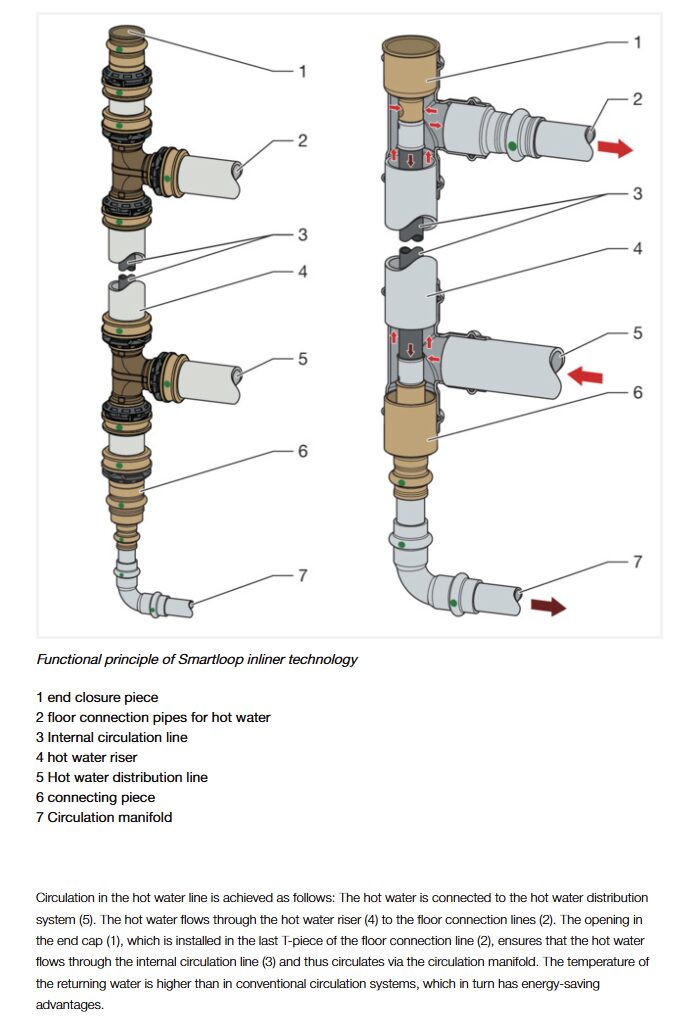
For above-ground distribution within a stacked apartment building a centralised plant in the basement feeding risers to each floor a different solution applies. The Viega Smartloop is a tube-in-tube system in which the return pipe runs inside the centre of the supply pipe. The return water therefore remains inside the supply pipe’s thermal envelope, retaining more heat than in a conventional separate-pipe circulation system. The compact loop halves the effective pipe length and concentrates the circulation path within a single riser, which suits the geometry of stacked apartments.
The design process for a centralised Passivhaus hot water system is:
- Calculate the loop losses from the pipe psi values, loop length, and temperature differential (water to ground).
- Check that the calculated losses fall below the PHI 10% threshold against the annual heating energy delivered including both losses (storage and distribution) and useful energy.
- Confirm with the mechanical engineer that any loop top-up energy is provided by the heat pump, not by an electric-resistance backup; If it is electric-resistance make sure to correct for the COP.
Several caveats apply. First, junction losses at fittings, tees, and connections can dominate the per-metre pipe-segment losses, so the design psi value needs to allow for these junctions. Second, the PHI 10% rule applies to the total heating network capacity used annually; peak-load losses may be higher and acceptable for short periods. Third, the analysis above concerns domestic hot water distribution; space-heating distribution raises different questions around operating temperatures and seasonal load variation, which warrant separate consideration.
References
Great conversation on LinkedIn where several awesome people helped me track down these components.