
I’m often asked to look at insulating external wall assemblies where the design team sometimes the construction team wants to strap and line the inside of a concrete or tilt-slab wall with fibreglass batts, timber studs and painted GIB. I tell them that’s a concern.
Internal moisture can cause condensation, or at least high relative humidity, on the face of the concrete. Mould follows.
Designers and builders will tell me they’ve done it before and haven’t had a problem. Never seen it. All news to them. They aren’t gaslighting me. But the field evidence keeps mounting.
Richard Cakar posted a photo on LinkedIn recently that’s worth a thousand of those conversations. It shows condensation forming on the inside face of a precast concrete wall that had been lined with fibreglass and gypsum board. This was in spring in Auckland not in Christchurch or Queenstown, not in some very cold climate. Just Auckland.
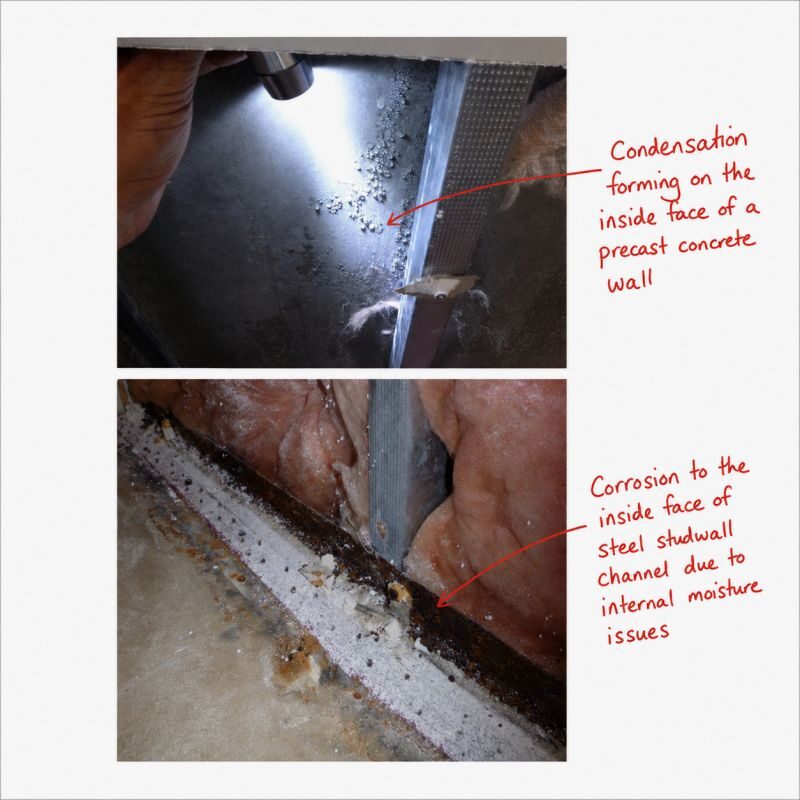
Photo by Richard Cakar and used with permission.
It’s not just Cakar. On our own EnerPHit project in Piha (https://sustainableengineering.co.nz/casestudy/piha-enerphit/), several of the concrete block walls had mould behind the fibreglass — visible once the insulation was removed.
Building Code clause E3 Internal Moisture has been far more vague than its external moisture counterpart, and there’s less guidance for designers on how to handle it. So when something goes wrong, it’s easy to blame a leak. Until it isn’t. The fix isn’t mysterious proper vapour control, external insulation where the assembly allows, and Mechanical Ventilation with Heat Recovery (MVHR) to manage internal moisture at source.
The point is, the photo doesn’t lie, and the field evidence is mounting. Mould behind fibreglass isn’t a mystery. It’s a design choice.
Source: “Internal Moisture Issues in Buildings Can Be Misdiagnosed” Richard Cakar, LinkedIn. https://www.linkedin.com/feed/update/urn:li:activity:7480334847216115712/