
US study shows Passive House cuts building energy use in half across all climate zones
A large US study by RDH for The Passive House Network confirms what building science professionals have known for years: designing to Passive House standards cuts total energy use by 50% to 75% compared to modern minimum building codes. Looking across seven distinct climate zones—from tropical Miami to freezing Minnesota—this research shows Passive House delivers consistent, predictable high performance that standard code enclosures simply can’t touch.
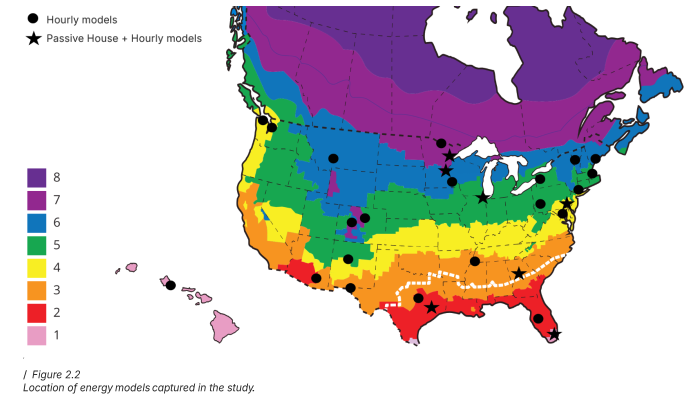
In New Zealand and Australia, we’re often told our climate is “different” or that local building codes are catching up. But the physics doesn’t care about geography. Modeling a four-storey apartment building, the study compared 2021 IECC and ASHRAE 90.1 code baselines against Passive House (PHI Classic, LEB, and Phius Core). Passive House scenarios consistently landed near 40 kWh/m2/year for Total Energy Use Intensity (TEUI), whereas code-minimum models burned through 90 to 180 kWh/m2/year. That is a massive 2x to 4.5x performance difference.
I loved how the authors translated the Passive House inputs into EnergyPlus hourly modeling software (which we use as well for dynamic zonal modeling). EnergyPlus reproduced almost exactly the same ultra-low energy results (within ~5%). Add in the third-party QA verification that comes with certification, and it’s clear Passive House provides the predictable, low-energy path our NZ and AU policy makers need to adopt.
This study by RDH Building Science compares a four-storey multifamily residential building across North American climate zones 1 to 7 under standard building codes (2021 IECC, ASHRAE 90.1) versus Passive House standards (PHI Classic, PHI LEB, Phius 2024 Core).
Reference: Sanchez, M. et al. (2026). Energy Standards Comparison Study – Task 2: Multifamily Residential Buildings. RDH Building Science Inc. & The Passive House Network.